
Working Together on Space Exploration as a New Frontier for the Development of Humanity
- Release date :
- Exclusive Interview
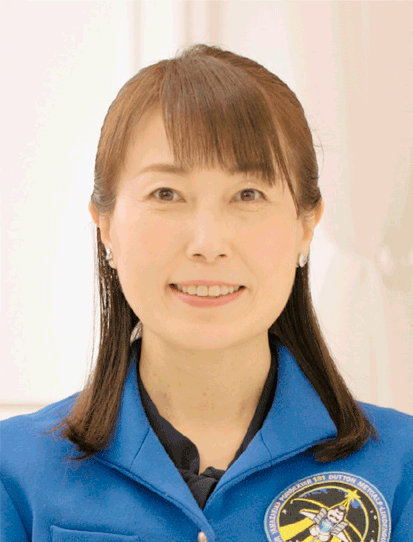
The Exclusive Interview for the Japan SPOTLIGHT May/June 2026 issue is with astronaut Naoko Yamazaki, who flew aboard on the Space Shuttle Discovery in 2010. As one of the few Japanese astronauts and a representative of Japan in efforts to utilize space as a new frontier for human progress, she is actively involved in various international initiatives. We spoke with her about her story, which is filled with big dreams and hope.(April 10, 2026)
Interest in Space
Haraoka First, regarding what sparked your interest in space, you mentioned that you were very interested in it since you were a child. I imagine there are various aspects to that, but was it a scientific interest, or was it more of a child's dream?
Yamazaki I think it was more of a dream than anything else. You see, back then, science fiction was really booming - with shows like "Space Battleship Yamato", "Galaxy Express 999", and "Star Wars" - so watching them, I just assumed that when I grew up people would go to space. Also, NASA's Voyager probes had just been launched and were sending back beautiful images of Jupiter and Saturn. I also enjoyed going to the planetarium, so I was naturally interested in the scientific aspects as well.
Experience on the Space Shuttle Discovery
Haraoka You spent about 15 days aboard the Space Shuttle Discovery and the International Space Station (ISS) in 2010. I'd like to hear about the details of your mission, what impressed you, what challenges you faced, or anything else you'd like to share.
Yamazaki When I first became interested in space as a child, there were no Japanese astronauts yet, so to me space was just something out of science fiction. But when I entered middle school, the first generation of Japanese astronauts - Dr. Mamoru Mouri, Dr. Chiaki Mukai, and Dr. Takao Doi - were selected, and as the International Space Station project began and Japan started participating, I sensed even as a child that an era was dawning in which Japanese people would truly play an active role in space. This was what actually sparked my interest in becoming an astronaut.
After that, I worked as an engineer at JAXA's Tsukuba Space Center, and later became an astronaut candidate. In 2010 - 11 years after I began training - I flew aboard the Space Shuttle Discovery on a mission to assemble the International Space Station (ISS) and replenish it with materials and scientific equipment. There were seven crew members, and my primary role was to operate the robotic arm. There was a supply module called Leonardo loaded into the Space Shuttle's cargo bay, and I used the robotic arm to retrieve it and attach it to the ISS. The resupply module contained various supplies and experimental equipment, and the seven of us then divided the work among ourselves to assemble each item in its designated location. My role was that of a "loadmaster" responsible for supervising the entire operation.
There were many things that left a deep impression on me. First, the fact that weightlessness itself creates a world so different from what we are used to on Earth, and the beauty of Earth as seen from space. Also, as the Space Shuttle gradually approached and docked with the ISS, the ISS - which had initially appeared as just a dot - began to fill the entire window as we drew closer, shining brightly in the sunlight.
From Earth during the day, I felt the beauty of nature, and from the lights of the nightscape, I sensed the power of human civilization. But when I saw the ISS floating there in space, I was also deeply moved by the power of humanity - realizing that through international cooperation, we are capable of creating something on this scale.
As for the challenges I faced, even after years of training, unexpected incidents inevitably occurred. Many unforeseen situations arose. Dealing with each one of those situations was a challenge in itself.
Haraoka From what I've heard, you have to pay close attention to very detailed work. Of course, since your specialty is aerospace engineering, it might not be that difficult, but even so, given that you're in the unique environment of outer space, did you ever feel a significant amount of pressure?
Yamazaki Yes, that's right. Once you're actually on site, you encounter challenges unique to that environment. No matter how much training you do, it's difficult to simulate weightlessness on Earth, so there are many things you only understand once you're there - or situations where your movements end up differing from what you'd planned. Getting used to that and relearning things on the job in my own way was both challenging and, in a way, that made it interesting.
Haraoka So while you were operating the spacecraft, you were also conducting various experiments?
Yamazaki Yes. We also took 15 mice with us to study changes in their immune systems and also grew plants.
Haraoka So you'd be collecting data, analyzing it, and really putting your mind to work?
Yamazaki Yes. It does require brain effort, and since we're in microgravity and just floating around, it might seem like it doesn't take much physical effort. But as we assembled all those devices, it actually ended up being quite physically demanding. Some of the devices were quite large, and while they were floating, their mass didn't disappear, so it took a tremendous amount of force to stop them and change their direction.
Training as an Astronaut
Haraoka As for the number of astronauts, while there are about 600 to 800 worldwide, just over 100 of them are women. In Japan, there are 11 JAXA astronauts with flight experience, and two of them are women.
Yamazaki In addition, there are two astronauts currently in training, one of whom is a woman. So including those in training, there are three female astronauts in Japan.
Haraoka I understand that you graduated from the Department of Aerospace Engineering at university. In the world of astronauts, have you ever faced challenges specifically because you are a woman? If so, how did you overcome them?
Yamazaki To be honest, I didn't really face any particular hardships just because I'm a woman. The training curriculum and the mission tasks after arriving in space were treated as the same for everyone. Given the diversity in terms of gender, age, nationality, and background - whether we came from the military, the private sector, or academia - I think being a woman was just one aspect of that diversity.
That said, although I trained for 11 years myself, the duration of training varies depending on the situation, but it is a long-term commitment. In particular, since Japan does not have its own crewed spacecraft, training is primarily conducted in the United States, though it sometimes takes place in Russia, Europe, Canada, or Japan. I think there is an inevitable need to train for many years in an environment away from one's home country.
So rather than a gender difference, the fact that it was a foreign environment actually played a much bigger role. Since I gave birth while in training and had to raise my child at the same time, I think it was my family and those around me who bore the brunt of the hardship, rather than me.
Haraoka So there are quite a few challenges when it comes to language, aren't there? Especially inside a spaceship, even the slightest miscommunication could lead to serious trouble. Did you notice that as well?
Yamazaki Yes, that's right. During our training, we regularly flew a two-seat jet trainer called the T-38. While navigating, communicating with the control tower, and handling various other tasks, we practiced ensuring clear communication in English right from the start of our training. However, since training terminology is fairly standardized, it was actually easier in that sense. In fact, I feel it took me longer to get used to daily conversation.
Activities as an Expert on Space
Haraoka You are currently involved in a wide range of activities related to space development. I'd like to ask you about each of these in turn. First, as the representative of Space Port Japan, you are working to establish Japan as a hub for space transportation in Asia. I'd like to hear an overview of those efforts. Will space travel become a reality in the near future? What challenges will you be facing?
Yamazaki There are already people traveling to space, and I believe an era in which this becomes increasingly widespread is just around the corner. Space Port Japan is a non-profit general incorporated association founded by a group of seven individuals sharing the same ambition for making Japan an Asian space transportation hub including for space travel. We've been working together by pooling our expertise - which includes lawyers, investors, marketing professionals, JAXA engineers, and aviation industry experts - and myself as an astronaut. Our primary motivation stems from the fact that a variety of spaceship launch methods will emerge in the future, and that will include crewed missions.
When that happens, Japan must be prepared to respond. Just as in the aviation industry, rockets will gradually adopt a "ride-share" model - foreign rockets launching from Japan, Japanese rockets launching from abroad, or, as an extension of aviation, high-speed point-to-point transport using spacecraft. For example, ultra-high-speed transportation connecting New York and Tokyo in just one or two hours could become a reality. It is said that such a world will arrive in the near future, within about 10 years. When that happens, the flow of goods and people will change dramatically.
We established Space Port Japan in 2018, but the year before that, Elon Musk actually announced a plan to connect New York and Shanghai in 39 minutes using Starship, a spacecraft under development. I believe that once Starship and other vehicles currently in development become operational, a new world of high-speed point-to-point transportation and space travel will open up.
The Global Spaceport Alliance platform also began in the US in 2015, bringing together spaceport stakeholders from around the world to discuss international collaboration between spaceports and what kind of spaceports will be needed in an era when spacecraft begin to arrive and leave in the world.
I believe that by engaging in these discussions from the very beginning, Japan will be able to establish itself as a true hub for Asia. While the aviation industry inevitably tends to concentrate more travelers in places like Singapore and South Korea, Japan aims to become the leading hub in Asia for space transportation and spaceflight. With this in mind, I launched this initiative because I believe we need to start taking action now and establish an organization that can serve as Japan's point of contact for the international space port community.
Haraoka So we can assume this will become a reality in the very near future?
Yamazaki Yes. Starship has been selected by NASA as one of the crewed lunar landers for the Artemis program, and NASA is working toward the milestone of landing its astronauts on the Moon in 2028. The same spacecraft that connects New York and Shanghai in 39 minutes will be used for this mission, so while it may require some further modifications for use as a passenger aircraft, I believe the era of high-speed travel between two major cities will surely arrive in the 2030s.
Haraoka So while there aren't many technical challenges, there are many things that require international coordination. Is that what makes it challenging?
Yamazaki Technically speaking, while the technology remains challenging - such as maintaining and reusing a spaceship for flying at high frequencies just like aircraft - I believe the regulatory framework is also a major factor.
Haraoka Next, let's talk about space education for children. You serve as the president of the Young Astronaut Club (YAC) Japan. Science education has become extremely important not only in space-related fields but across a wide range of disciplines, and with the increasing use of technologies like AI, it seems no longer appropriate to divide education into science and humanities tracks: we have entered an era where everyone needs to study science.
Space, in particular, has become an important field that offers a wide range of research topics, as it encompasses not only astronomy but also diverse scientific disciplines such as meteorology, medicine, and data science. I think it is important to teach these subjects from an early age as essential knowledge, regardless of whether their academic interest is in the sciences or the humanities. What do you think?
Yamazaki I think you're absolutely right. Of course, many children are interested in space, but the children who participate in the Young Astronaut Club (YAC) aren't all just interested in space - there are all kinds of kids, including those who love biology.
Our program is built on three pillars: nurturing children of the universe, children of the Earth, and children of science. We hope that each student will develop scientific thinking while maintaining an interest in the world around them. Regardless of whether they pursue the humanities or the sciences, we believe this involves the ability to think scientifically - to determine for themselves what conclusions can be drawn from various data, what is known, and what remains unknown. We also believe that these are skills everyone should possess.
I also believe that since so many children - from various grade levels across different generations - learn together, this provides a great opportunity for them to develop teamwork skills. There is also a positive cycle where, after graduating from YAC, many return as leaders, often around the time they are in college, and take on the role of teachers themselves. However, since the majority of graduates eventually move on, we established a "Fellow" system to ensure they can still access this information and participate in our activities from time to time. We created a system where graduates - and even adults who are not graduates but wish to engage with these activities - can participate as Fellows.
Haraoka I believe we are currently seeing a significant surge in technological innovation, particularly in the field of AI. As you know, the global economy is facing challenges, such as immigration issues, but I think many of these problems could be resolved by boosting the economy's potential growth. In that sense, I have high hopes for innovation. With regard to space, is it safe to assume that technological innovation will continue to flourish?
Yamazaki I, too, recognize that the space industry is growing globally. It is said that by 2040, its market size will exceed 140 trillion yen, which means it will surpass the current aircraft industry. Therefore, I believe we are entering an era where it will no longer be a niche industry but will become a core component of the industrial sector.
While the rocket and satellite industries are significant, various experiments are also being conducted on the ISS. These include research on new materials, new drugs, and analyses of previously unexplained functions within our genetic structure. So I think there will be many technological innovations stemming from the ISS. I also feel that AI will accelerate the pace at which we improve manufacturing processes and data analysis methods.
Haraoka It seems that the number of space startups is growing rapidly. Companies like Astroscale, Infostellar, and ALE are emerging in Japan, which is very interesting. What kind of potential do these space startups hold?
Yamazaki Currently, the government's policy is to actively foster the growth of startups, and I feel that space policy is also shifting significantly toward supporting them. Programs like the Small Business Innovation Research and the Space Strategy Fund are creating environments where startups can thrive, and the recent increase in startups originating from JAXA is a major trend of the past few years. At organizations like JAXA, much of the expertise cultivated by the government has often been confined to specific projects or, in some cases, left unused. By having startups aim for proper commercialization, I think this intellectual property will be disseminated and utilized more efficiently.
So I view startups as valuable drivers of innovation that serve as a bridge between the academics in the public sector and the business: they facilitate the transfer of the vast R&D expertise accumulated by JAXA - originally a research and development organization - from the public sector to the private sector, ultimately leading to industrialization.
Haraoka Would it be fair to say that Japanese space startups are gradually gaining ground on the international stage?
Yamazaki Yes, I think so. A positive cycle is taking shape, where the first generation of startups has grown to such an extent that they've surpassed the typical scope of a startup, and as a result the next generation of startups is emerging in their footsteps. But space development is a long-term endeavor, and since other countries are also strengthening their support measures, I think Japan needs to strengthen support that enables its startups to remain competitive.
Haraoka Rocket development involves a great deal of risk, and in Japan it is primarily led by JAXA, a government agency. I understand that in the US, rocket development has been left to the private sector since 2012. While cost reduction is cited as the main reason, I wonder if Japan will also enter such a private-sector-led era.
Yamazaki Yes. It has already begun. Rockets for launching small satellites represent a field that core rocket manufacturers have not previously developed, and demand for very small satellites is growing rapidly due to satellite constellations. In this context, JAXA has begun procuring services from the private sector to launch various innovative demonstration satellites. We are entering an era where the government purchases services from the private sector.
However, I don't think this will immediately take off. With so many rockets in the world, I personally believe it's crucial to first establish a solid track record. The public and private sectors must work together, with the government supporting the private sector and providing close guidance until a solid track record is built. As the private sector grows from government support into an industry, the scope of what the government can do will expand as well. So I think this shift from government to private sector is important for Japan.
Haraoka Private rocket companies such as Space One are gradually emerging in Japan, but they have yet to succeed in placing a satellite into the desired orbit. These private companies are currently going through a process of trial and error. How would you assess their progress?
Yamazaki First of all, I would like to express my respect for their decision to take on the risk of developing rockets as a private company. Moreover, rocket development is a convergence of various industries. It brings together electrical engineering, thermal engineering, mechanical engineering, as well as software and hardware, a wide range of disciplines, making it a field with a broad scope. I think it is a field that could even be described as a "battle of intellect". So, I believe Japan's possession of rocket technology is the foundation for all space development.
While the government is developing its own liquid-fueled and solid-fueled launch vehicles as core rockets, however, various new forms of space transportation are emerging that cannot be fully addressed by these core rockets alone. Major examples include launching small satellites with high maneuverability, manned spaceflight, recovering launched objects, and hypersonic vehicles - such as spaceplanes that are a hybrid of aircraft and rockets. As these diverse options emerge, I think we will see an increasing number of cases where the private sector takes the lead and the public and private sectors work together, rather than relying solely on core rockets to handle everything.
While one of the main goals of launching small satellites today is to meet the growing demand for them, I also see it as a touchstone for Japan's ability to adapt to an even wider range of space transportation that will be needed in the future.
Haraoka Would it be fair to say that, like the aircraft industry, the spillover effects on other industries are significant?
Yamazaki Yes, it would. I also think there will be significant spillover effects for the region, such as various space-related industries clustering around the launch site, and the expectation that local high schools will offer space-related courses, attracting students from all over the country.
Haraoka Space development is a highly competitive international field, so the ability to cooperate internationally is a major challenge. In that regard, you were also involved in the Open Space Colony concept. Could you tell us more about that concept as well?
Yamazaki This is one of the concepts being developed by a startup called Space Data. I also helped out when the Open Space Colony concept was first being developed.
The ISS is scheduled to be decommissioned in about five or six years, though that timeline might be extended slightly to around 2032. In parallel, private space stations will emerge. I currently serve as the general manager of the Japanese branch of one such company, VAST, and as various projects like space hotels and private space stations begin to take shape, the idea is that if we all pool the intellectual property we've cultivated so far and collaborate on development, we can accelerate progress even further. The goal is to gather wisdom from around the world.
For example, there's a helicopter called Ingenuity that was sent to Mars in 2021 as part of NASA's Mars exploration mission. It successfully completed the first powered, controlled flight by an aircraft on a planet other than Earth. During its development, more than 10,000 people contributed to the software development on GitHub, and that's how the helicopter's software was created. This kind of collaborative environment is gradually taking shape at NASA as well.
Haraoka I've heard that the US-China rivalry is having a significant impact even in space. What are your thoughts on that?
Yamazaki In particular, the manned lunar landing the US is aiming for under the Artemis program - the first since Apollo - is driven by the competition with China, mirroring the dynamics of the old US-Soviet space race. Lunar exploration has an element of "first come, first served". Even though the Outer Space Treaty states that celestial bodies do not belong to any country, once a nation actually goes there and establishes a base, that area effectively becomes off-limits to others - creating a situation where they can effectively "corner" it. That is precisely why there is such a rush to develop these resources quickly.
Haraoka We need to enact laws to ease tensions. Are there any efforts underway to establish international laws?
Yamazaki Since it's difficult to revise the Outer Space Treaty, the US has taken the lead in creating a soft-law instrument known as the Artemis Accords, and about 60 countries have signed on to it.
Space as the New Frontier for Human Progress
Haraoka While space is likely to become a new frontier for human development, I would like to hear your thoughts on what challenges we must overcome to achieve this and what solutions might be available.
Yamazaki As you mentioned, I do think space is a new frontier. The scope of that frontier is gradually expanding, and with the next private space station as a foundation, a path leading all the way to the Moon and Mars is finally coming into view. I think we are currently at a turning point.
There are various challenges we must overcome, but one key issue is the order of space. With private-sector activity - which was not anticipated by the Outer Space Treaty - becoming this active, and the number of satellites increasing, we must address how to manage traffic control between satellites and how to deal with space debris. International cooperation and a space order are indispensable for the sustainable use of space.
Furthermore, I believe efforts to make space more accessible by lowering costs for it, as well as technological innovations to enhance safety, are also important. Looking further ahead, as humanity works to solve various challenges on Earth, it is crucial to cultivate an awareness that we are not limited to finding solutions solely on Earth, but that space is also an option. We need to adopt a mindset that recognizes the potential to solve Earth's problems while utilizing space. We, too, intend to continue pursuing such possibilities.
Haraoka So what you're saying is that we need to establish a rules-based cosmic order to bring about such positive developments.
Yamazaki Yes, I agree.
Haraoka Finally, if you don't mind, I'd like to ask you to share your thoughts on how you hope to contribute to space development in the future.
Yamazaki In 2025, the Japanese branch of an American company called VAST, aimed at building the next private space station following the ISS, was established, and I am currently involved with it. I believe that in order for humanity to properly expand its activities in space, it is essential to first strengthen Earth-orbiting space stations. While the ISS was a government project, I think one of the challenges is whether we can create an economic ecosystem that includes the private sector. I believe that only once an ecosystem is established in Earth orbit can we expand to the Moon and Mars.
I am delighted to be involved in this endeavor, and through international cooperation, working together with Japan and various other countries, I am committed to laying the groundwork and creating a space that everyone can utilize.
Haraoka Thank you very much for your concise and clear remarks.
Written and translated by Naoyuki Haraoka, editor-in-chief of Japan SPOTLIGHT, with the cooperation of Tape Rewrite Co.