
Roundtable on "Can Pop Culture Serve as a Bond Between Asian Countries?" (March 24, 2026)
- Release date :
- Roundtable
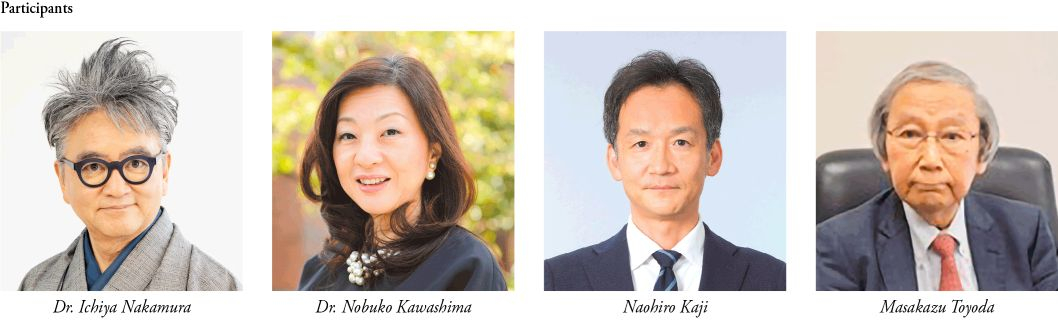
Participants:
Dr. Ichiya Nakamura President, Professional University of Information and Management for Innovation (iU)
Dr. Nobuko Kawashima Professor of the Faculty of Economics, Doshisha University
Naohiro Kaji Director, Culture & Creative Industries Division, Commerce and Service Industry Policy Group, Commerce and Information Policy Bureau, METI
Masakazu Toyoda Chairman & CEO, Japan Economic Foundation (JEF)
Abstract of Discussion
• The Japanese content industry has already reached the status of a core national industry with overseas sales and sales through the Internet. Its growth potential is considered extremely high in the light of continuing popularity overseas and its background of diversity in storytelling.
• Its significant ripple effect on other sectors like tourism is also notable.
• It is important for Japan as a nation to encourage private-public partnerships to support this promising cultural and creative industry.
• By promoting international exchanges and cooperation among Asian nations with attractive contents industries, it would be possible to achieve stronger bonds between them. This would be an effective utilization of soft power.
Introduction
Toyoda The popularity of Japanese pop culture is on the rise worldwide. As Prof. Ichiya Nakamura, who is joining us for this roundtable discussion, has mentioned, approximately 250,000 people attended the Japan Expo in Paris, and about 400,000 attended the Anime Expo in Los Angeles. I've heard that attendance at the latter was only between 50,000 and 80,000 in the early 2010s, so this surge in popularity has been rapid. Regarding the scale of the industry, if we look at the content markets of major countries, Japan ranks third, following the United States and China. Next come the United Kingdom, Germany, South Korea, and France.
Today, I would like to ask you to discuss the state of Japanese pop culture from four perspectives. First, what are your thoughts on the industry's growth potential? Second, what distinguishes Japanese pop culture from that of the US, Europe, and China? Third, can pop culture serve as a bond connecting the diverse nations of Asia? This is the main topic. Finally, I would like to ask about your expectations for the government and what role it should play to facilitate further development. I hope we can discuss these topics from these four perspectives.
We have gathered three experts here today. First is Prof. Nakamura, who currently serves as president of the Professional University of Information and Management for Innovation. Next is Dr. Nobuko Kawashima, professor in the Faculty of Economics at Doshisha University. And representing the government is Mr. Naohiro Kaji, director of the Cultural & Creative Industries Division at the Ministry of Economy, Trade and Industry. Thank you all for joining us.
The Potential of the Content Industry
Toyoda First, I'd like to begin with pop culture as an industry. It is said that in 2023, Japan's content market exceeded 14 trillion yen, with exports to overseas markets reaching 6 trillion yen, making it an industry on a par with steel and semiconductors in terms of scale. Prof. Nakamura, does the content industry still have room to grow? Specifically, what areas should we focus our efforts on?
Nakamura The government has redefined the content industry, reclassifying it from a "growth industry" to a "core industry" and thereby clarifying its status as a major sector. The global market is worth approximately 180 trillion yen and is growing at an annual rate of 5%.
Within this market, Japan ranks third behind the US and China, yet it accounts for only about 7% of the global market. In the global IP (intellectual property) sales rankings, four of the top 10 - including "Pokémon" and Hello Kitty - are Japanese, yet sales remain relatively small. The anime and game markets have doubled over the past decade, and looking at the global market, I believe there is significant room for further growth.
The major challenges to date have been overseas expansion and online expansion. Recently, progress has been made in these areas: overseas sales have reached 6 trillion yen, quadrupling over the past decade, and the industry has become the second-largest export sector after automobiles. Furthermore, the share of online sales - which stood at 13% of the total in 2011 - has now reached nearly half. In other words, the expansion of the content market is largely driven by overseas and online growth.
However, while most overseas sales come from anime and games, live-action films, music, and manga have also seen robust business growth in recent years, raising expectations for further expansion across the entire content sector and pop culture as a whole.
Another challenge, alongside global expansion and digitalization, is how to maximize spillover effects. While the content industry itself is worth 14 trillion yen, when you factor in related industries such as licensed merchandise, events, and related equipment, the total market size is estimated to be 100 trillion yen. I believe it is crucial for the industry to use content as a driver for broader economic spillover to expand these ripple and external effects. Although we refer to this as the "Cool Japan" strategy, I don't think we've yet mapped out an effective roadmap for it.
Toyoda Thank you. Next, I would like to ask Prof. Kawashima a question. I understand that you have stated that the Japanese government's cultural industry strategy, the "Cool Japan" strategy, has "highlighted the priority areas of various government ministries and agencies, with its goals changing and evolving over time" and that you suggest there might have been a different approach. As a strategy for fostering an industry, what specific perspectives do you consider important?
Kawashima I think we should distinguish between a cultural industry strategy and the "Cool Japan" strategy. My concern regarding "Cool Japan" has been that its goals and the vision it seeks to achieve are vague; there is also inconsistency depending on the context as to whether it is intended as a diplomatic tool, a national branding strategy for Japan, or a means to enhance Japan's economic power. Joseph Nye's theory of soft power, which the "Cool Japan" strategy originally drew upon, is fundamentally aimed at enhancing a country's status and influence within the international community. Meanwhile, Douglas McGray, another major theoretical pillar of the strategy, argued that it should be applied to Japan's economic strategy. We can see the two commend culture for two different purposes.
Coincidentally, these two authors began to be widely read among Japanese intellectuals around the same time, exerting a tremendous influence. However, since fundamentally different objectives were intermingled, the Cabinet Office's Intellectual Property Headquarters, which was tasked with coordinating them, has been working to foster collaboration among various ministries and agencies. I do commend their efforts to break through Japan's tendency toward siloed bureaucracy by promoting "Cool Japan" as a unifying concept to consolidate various initiatives being pursued by different ministries. Yet, these efforts have not been backed by concrete results.
Within this context, the strategy for the cultural industries - which I originally considered the most important, encompassing both the content and creative sectors - sometimes were pushed to the backyard. Depending on the period, the focus shifted to simply boosting inbound tourism or revitalizing regional economies. However, starting in 2024, the emphasis has begun to shift back toward cultural and industrial strategies again, and with the Ministry of Economy, Trade and Industry (METI) having launched a full-scale Industrial Policy Research Group, I believe we have come full circle after more than a decade.
As for the "Cool Japan" strategy itself, my assessment is that it has been little more than a slogan and cannot be described as a policy backed by concrete action.
Toyoda Thank you. Mr. Kaji, your section is called the Cultural & Creation Industries Division. While I believe there is significant growth potential in the content industry and other pop culture-related sectors, what growth strategy is the Cultural Industry Section focusing on?
Kaji From the perspective of METI, our focus is on implementing robust economic and industrial policies to foster profitable industries and ensuring substantial public-private investment. This is because we have entered an era where countries no longer rely solely on slogans or institutional reforms.
It is widely recognized that we have entered an era where industrial policies and strategies are standard practice in fields such as semiconductors and decarbonization. Meanwhile, as we have investigated in study groups and demonstrated with data, I believe we have actually entered an era of industrial policy for the content and cultural creative industries as well.
In this context, my personal view is that while the private sector in Japan has been working very hard up to now, the country has not fully adapted to the global trend toward public-private investment. For example, in the US, state governments offer tax breaks for the production of live-action and animated films, and more recently, video games as well. These state tax breaks total 600 billion yen. California alone provides 100 billion yen in tax breaks. China, on the other hand, provides at least 100 billion yen in direct subsidies, and as a matter of course imposes pre-censorship and regulations that restrict the distribution of foreign-funded works. France is no exception, offering support on the scale of 100 billion yen while also imposing restrictions on foreign investment.
While South Korea does impose total volume restrictions on foreign investment - though these may not have a significant impact - it has established an organization called the Korean Creative Content Agency (KOCCA) and invests a massive annual budget of 76 billion yen through public-private partnerships to fund K-pop and other content. Although Japan and South Korea both began moving to subsidize the content industry through public-private partnerships 20 years ago, I believe many Japanese people feel that while Japan maintains a strong presence, its overseas sales have not yet reached a level commensurate with the industry's potential.
I think we need to shift our perspective, invest through public-private partnerships, reposition this industry as a profitable sector within industrial policy, and have the government take on some risk to revitalize it.
Toyoda Prof. Nakamura, do you have any comments in response to what Prof. Kawashima and Mr. Kaji just said?
Nakamura From the perspective of the content industry, we've long struggled with the distance between us and the government. While some argue that our growth was due to this very distance, I think it is a crucial point that fostering the contents industry should be properly recognized as an industrial policy - that is, as a national policy - and I felt this was a message that the industry as a whole should take seriously.
Furthermore, regarding "Cool Japan", I believe it is time to redefine and relaunch as its definition, policy scope, and objectives have all become ambiguous. This stands in contrast to the industrial policy for fostering the content industry that Mr. Kaji is implementing, which has a clear scope and well-defined objectives.
Characteristics of Japan's Content Industry & Pop Culture
Toyoda Now, let's move on to the second topic. I'd like to hear your thoughts on the characteristics of Japanese pop culture. It is often said that the US has a broad-based pop culture, while Japan excels in specific areas. China and Europe also have their own distinct cultural traditions. Prof. Kawashima, compared to the US, Europe, and China, how would you describe the defining characteristics of Japanese pop culture?
Kawashima It's difficult to make direct international comparisons, but one distinctive feature of Japan is that its pop culture has a much longer history than China's. I believe it's been about 20 years since China began focusing on animation, games, and live-action films as part of its creative industry policy, but Japan's history of live-action films for example dates back to before World War II. In that regard, Japan stands shoulder-to-shoulder with the US and Europe, having nurtured many creators with deep knowledge of film production and the relevant technologies. I believe this long history of accumulation makes Japan an outstanding and exceptional country within Asia.
When it comes to video games, the industry began simultaneously around the world in the 1980s, so I don't think Japan was unique in that regard. However, regarding console games, other Asian countries like China and South Korea did not develop them, whereas Japan started there and then moved into mobile games. It is a country characterized by having started late in mobile games but having fought on both the hardware and software fronts while developing its technologies.
The second point is the tremendous diversity within each field. As is often said about anime and manga, there are manga like "The Drops of God" that explore the world of wine, as well as all kinds of action stories and coming-of-age tales. There are also long-running series aimed at children, like "Sazae-san", which are entertaining for anyone at any time, and mystery dramas like "Detective Conan". The world of anime and manga offers a little bit of everything, and I believe this is one of its defining characteristics.
The US also has a thriving animation industry, but because American studios operate with the global market in mind as a fundamental premise, it's difficult for them to tackle niche themes. They specialize in adventure and fantasy stories designed to move families around the world; their technical skills are outstanding, and their content is entertaining for viewers of all ages, no matter where they live. As a result, each film earns at least US$1 billion at the box office. However, I believe there are many American or international fans who are hooked on Japanese anime because it satisfies their desires in ways that the beautiful worlds of stories like coming-of-age tales cannot.
Just as there is diversity within this single genre, the volume is also immense. An extraordinary number of anime and manga titles are produced year after year. The competition to rise to the top within this landscape is fierce, which in turn drives the high quality of the content. A major strength is the sheer abundance of anime across diverse genres, primarily broadcast on television. Especially now that we live in an era of streaming via platforms like Netflix, if viewers happen to stumble upon something interesting but their demand for "What's next?" isn't met, they'll quickly lose interest.
For example, there are so many Korean dramas that it's impossible to watch them all. New ones are constantly being released, so you can keep binge-watching one after another. Japanese pop culture is characterized by a similarly vast - or even larger - volume of content, and because of its long history, it forms an enormous pool of material when you include older works as well.
The third characteristic is that the more niche aspects are gaining traction overseas. While Korean and American content are aimed at the mainstream market, in Japan, Studio Ghibli is probably the leading example of content that can reach a mass audience, along with a few video games. Other than that, I can't think of any off the top of my head. Japanese content may not be aimed at the mainstream market, but rather represents the sum total of subcultures.
Toyoda Thank you very much. That was very interesting. Mr. Kaji, how do you view Japan's unique characteristics compared to the US, Europe, and China, and where do you plan to focus your support?
Kaji I believe there are three main factors. The first is 2D content, the second is storytelling ability, and the third is diversity.
Regarding 2D content, I think Japan is exceptionally strong in this area. Anime and manga are read and watched all over the world. The term "manga" is now used worldwide, and a distinct genre - different from American comics and different from comics in general - has been firmly established overseas. These works serve as source material for video games, anime, and sometimes even live-action adaptations. Of course, there are 3D games as well, but since they all originate from 2D - including games that allow players to draw their own illustrations - I believe they are a true treasure of Japan that we should be proud of.
As for storytelling ability, I meet with government officials and various other people from overseas, and everyone - including those from China - frankly tells me that they find it difficult to match Japan's storytelling. While some people overseas do say that their technology is already superior, I believe Japan is still quite skilled when it comes to crafting narratives.
The third factor is diversity. With no prior censorship or volume restrictions, Japan is, as far as I can tell, the freest market. Within this environment, we see a wide range of stories - not just those that reward good and punish evil, but also ones where the protagonist is vulnerable. Moreover, it's not just the diversity of content; Japan consistently produces live-action works of artistic merit that attract global attention. We have identified games, anime, manga, music, and live-action film as our five key content sectors, and I believe there are very few countries that possess all of these to a comparable degree. I think this ability to create diverse stories across diverse genres is one of Japan's greatest strengths.
Toyoda Prof. Nakamura, how do you view the characteristics of Japanese pop culture? Where do you think we should focus our efforts?
Nakamura I believe that pop culture, or popular culture, has existed for a very long time, dating back to the Heian period. Based on that, I think there are roughly three defining characteristics.
First, the forms of expression are diverse and free. Manga, anime, and video games span a wide range of genres, from serious works to highly unconventional ones. This is because there are no constraints imposed by religion or social class, allowing for free expression; for example, anime like "Dragon Ball", which is all about fighting, would never have been produced overseas.
Second, it is a culture of the common people. It is neither aristocratic nor samurai culture; rather, it has been sustained by the masses, the common folk. Furthermore, the boundary between adults and children is blurred. While in the West, pop culture is considered the domain of children, in Japan adults devour manga.
The third element is participation. Because creative expression is widely accessible, we can hold manga doujinshi events attended by tens of thousands of people; and because everyone can play the recorder, people compose and perform music, creating artists like Hatsune Miku. This is something that could only have happened in Japan.
I think these foundations rest on two pillars: freedom and education. I think it is crucial to protect freedom of expression and to maintain education in creative expression within primary and secondary education.
Pop Culture as a Bond Between Asian Nations
Toyoda The third issue - and this is today's main theme - is whether pop culture can serve as a bond for Asia. Asia is diverse, with a wide range of historical, religious, and institutional differences. On the other hand, each country has its own outstanding pop culture; whether you watch movies or listen to music, it is diverse and each has its own merits. I feel that the exchange of pop culture could help diverse nations live together harmoniously and happily. Mr. Kaji, I think it would be wonderful if film festivals were held with countries inviting each other to participate. What do you think?
Kaji Exactly as you say. I certainly hope that will be the case. Personally, I believe this business - where consumers are happy to pay to enjoy entertainment - is a very important industry, both economically and culturally. In particular, our relationship and bonds with Asia are extremely important. As you mentioned regarding film festivals, we run the Tokyo International Film Festival through a public-private partnership. Even within the festival itself, we operate with a focus on Asia by organizing exchanges with Asian students and setting up sections dedicated to screening Asian films.
In addition to the film festival, we also host a trade market. It's called TIFFCOM (Tokyo International Film Festival Content Market), and the Tokyo International Trade Market is held concurrently. At this trade market, China, South Korea, and other Asian countries participated last year. In terms of collaborating not only with East Asia but also with Southeast Asia, we are conducting these activities with a strong awareness of Japan's position within Asia and through close cooperation.
Furthermore, when it comes to music festivals, the question of what kind of live performances to stage in Asia is a topic that inevitably comes up for discussion, just as it does in North America. In the anime sector as well, with overseas audiences wanting to watch shows with the original Japanese voice actors and subtitles, Japanese anime is becoming to them what Hollywood films are to the Japanese. In that sense, I believe Japan and South Korea have the potential to become leaders as major content powerhouses within Asia.
Toyoda Prof. Nakamura, recently, when we look at Ukraine, Iran, or Latin America, chaos seems to be everywhere. If Japanese pop culture is popular in Asia, doesn't that mean Japan possesses soft power? Countries like China, South Korea, India, and Indonesia all have wonderful pop cultures of their own. Could Japan not use its influence in pop culture as soft power to forge bonds across Asia?
Nakamura In South Korea, anime like "Slam Dunk" and "One Piece", as well as J-Pop artists like YOASOBI, are incredibly popular. Last year, I attended an otaku event in Hong Kong that drew 1 million visitors over five days. Even if there are political differences, our cultures are blending together. In France, "Dragon Ball" once became a social issue, and in some Islamic countries "Pokémon" became so popular that it was banned in some cases. However, I think we should leverage these very issues as a form of soft power.
Japan is in a unique position to engage with the world - not just the US and Europe, but also Asia and the Middle East - and I believe it would be beneficial to advance cultural diplomacy with pop culture as a central pillar. I think we should focus on strengthening cultural exchanges with China at the grassroots level, as this can have a positive impact on our economies and politics. Similarly, I think it would be beneficial for Japan and South Korea to collaborate on an industrial level. From a perspective outside Asia, Japan and South Korea are often perceived as part of the same cultural sphere, so I believe it is important to take an approach where we team up to tap into global markets.
Toyoda Prof. Kawashima, rather than limiting ourselves to "Cool Japan" - though the definition may be important - mightn't we need a "Cool Asia" policy? What do you think of the idea of eventually expanding that concept to the rest of the world?
Kawashima I think we've already moved quite a bit toward "Cool Asia" before we even reach the stage of deciding whether or not to pursue it as a policy. Even before that, the idea that Japanese culture connects Asia has been happening quite organically for a long time. For example, people in Hong Kong often tell me that they grew up watching Japanese anime.
Japanese anime were commonly watched in Hong Kong, Singapore, and Southeast Asia, and the genre of Japanese "trendy dramas" from the 1980s and 1990s was well-received across Asia. Stories about young men and women navigating urban life in Tokyo were attractive, and these dramas became extremely popular in developing places like Taiwan, Hong Kong, and Singapore during that era.
From there, as countries like Indonesia, Vietnam, and Malaysia - and, ahead of them, Thailand - gained economic power and began absorbing various cultural influences, establishing new broadcasters and catching up with Korea and Japan, K-Pop and other K-content successfully found their way into that landscape. At that time, Japan was just entering the early stages of its "Lost Decade" and perhaps it wasn't making much of an effort to actively spread its culture throughout Asia - or perhaps it simply didn't have the resources to do so.
Amid all this, K-pop, K-content, and now K-beauty, the beauty industry, and even food - it's almost as if South Korea has taken control of these sectors. The fascination with South Korea is incredibly strong in Southeast Asian countries, and I think it's wonderful that this has spread worldwide to Latin America, North America, Africa, and the Middle East. However, the uniqueness of Japanese pop culture is striking, and it is diverse; I've even been told by people in Asia, "Japan is the cultural powerhouse of Asia." I believe Japan is held in high regard as a country that possesses strong originality and creativity, as well as a robust production infrastructure.
I've been thinking that we should focus a bit more on international co-productions going forward. While there are occasional co-productions between Japan and South Korea, such as TV dramas and live-action films, which are quite interesting, Koreans do respect Japan's live-action film culture, given its long history. Koreans often tell us there is still so much to learn from Japan's visual culture, but in recent years it seems that because Japan's production budgets are too small compared to those of South Korea and China, we're often not taken seriously, making it difficult to secure opportunities for co-productions.
This is something we need to address. Additionally, I believe there is still great potential for international co-productions with Europe, such as "The Drops of God" - a drama (starring Tomohisa Yamashita, currently streaming on Hulu) that goes between the vineyards of Bordeaux and Burgundy in France and the cutting-edge urban landscape of Tokyo.
Expectations for the Government
Toyoda I'd like to move on to comments directed at the government. I'd like everyone to share their views, and then Mr. Kaji to respond to them. First, Prof. Nakamura, what would you like to say to the Japanese government?
Nakamura I serve as the head of the secretariat for a group called PPP (Pop Power Project). This is a community that brings together companies, creators, and researchers in the content industry, and Prof. Kawashima is also a member. This group of volunteers recently issued a policy proposal. The seven-point policy proposal includes support measures such as expanding the government budget to 100 billion yen, alongside initiatives for human resource development, corporate support, AI, anti-piracy measures, and strengthening central coordination functions. All of these are important, and I believe we have a comprehensive set of action items. However, what I hope for most is that the government further raises the priority of content policy.
We have finally been included in the government's strategic sectors - one of the 17 designated areas - but I believe that generating revenue through cultural industries that incorporate AI is Japan's most critical strategy, and I hope the government will demonstrate a stronger presence in this area.
Toyoda Thank you. Prof. Kawashima, what do you think?
Kawashima To be more specific, South Korea has an organization called KOCCA, mentioned earlier, which is well known within the industry, and I think it would be great if Japan could establish a similar organization. KOCCA is essentially a government-affiliated body with its own budget, and it oversees all aspects of content promotion. They have experts on the staff, and their mission is to boost the power of Korean content. To that end, they roll out various projects and programs, implementing a wide range of policy initiatives - including, for example, improving conditions for workers in content industry. Behind the scenes, the government firmly recognizes the importance of cultural industry policy. This is where we've fallen significantly behind South Korea. However, momentum has been building within Japan and the government since around 2024, so I really hope they'll make this a higher priority going forward.
To that end, I think we need to further refine the theoretical basis and justification for the government's focus on content policy. Otherwise, it will be difficult for those leading the charge to carry out their work, and others will find it hard to accept, so I think we need to flesh out that aspect a bit more.
One factor is the magnitude of the ripple effect. It has been empirically demonstrated that the ripple effect of anime, in particular, is immense, and this is likely one of the key concepts underpinning METI's industrial policy. Furthermore, IT and AI are now part of our social infrastructure. While the widespread adoption of these new technologies by the general public is absolutely essential for advancing Japan's digitalization and overall digital transformation (DX) and further accelerating technological innovation, I believe that content is what will help make this happen.
If the habit of watching content on platforms like Netflix has become so deeply ingrained, it is because there is content that everyone wants to watch. Furthermore, for the past 10 to 20 years, we have been in an era where people use various electronic devices for content creation , distribution and consumption - such as smartphones and iPads - to try things out for themselves or constantly engage with content created by others or by themselves, and this is all thanks to content. I believe there is a cycle in which the existence of content, entertainment, and media drives people to acquire new technologies and refine their skills; as their expectations and standards rise, this in turn drives progress on both the production side and in technological development. This is what I consider to be the second theoretical pillar of my argument.
Another aspect is a bit more of the soft power story: I think it serves as a crucial pillar for fostering bonds within global and Asian societies, and for earning respect for Japan within the global community.
Toyoda Thank you. Some people say that while AI has its advantages, it also has its drawbacks. Do you have any thoughts on that, Prof. Kawashima?
Kawashima There's no doubt that AI will dramatically boost productivity in the content industry, but the biggest concern for people on the front lines is how to balance and manage this with their own creative abilities. Six months ago, we could only produce disjointed footage, but the pace of evolution is rapid, and things are changing day by day. Therefore, it will likely be impossible in the future to engage in content creation or production without understanding AI. Creators will be expected to effectively harness this power moving forward. While this is a challenge, I view it as fundamentally positive.
Toyoda Thank you. I'd like to ask Mr. Kaji to explain what the Japanese government plans to do moving forward, including with regard to AI.
Kaji Regarding AI, while it goes without saying that creators' rights must be respected to the fullest extent, I think a key challenge is how to create an environment that encourages the government to move forward without undue hesitation. It is also crucial to prioritize support for the content industry and see it through to the end. I think it has become more commonplace than in the past for the public and private sectors to jointly discuss support measures and the challenges they should tackle together, so I think the key is simply to continue this process.
In these discussions, we are explaining and thoroughly debating the ripple effects and positive economic externalities within our study group, but I also believe that support for the content industry may be strategically indispensable.
In other words, while there are certainly economic ripple effects, such as boosting inbound tourism, I believe that having people around the world view Japan as a beloved country and wish for it to continue creating new content is linked not only to the happiness of its citizens and international exchanges, but also, in a broader sense, to national security. Therefore, it is crucial that we fully leverage this existing strength. I often hear the argument that the government shouldn't support sectors that already have strengths, but I think there is a legitimate justification for the government to intervene in the form of support - as long as there are positive externalities - to help build on those strengths. I intend to explain this to the public in a convincing manner.
Toyoda Thank you very much. I would like to see Japanese pop culture used as a bridge - first to connect Asia, and now to help heal the divisions in our troubled world. Thank you very much for having joined the discussion today.
Written and translated by Naoyuki Haraoka, editor-in-chief of Japan SPOTLIGHT, with the cooperation of Tape Rewrite Co.