
Roundtable: Building a Healthier World Through Medical Tourism (On Oct. 10, 2025)
- Release date :
- Roundtable
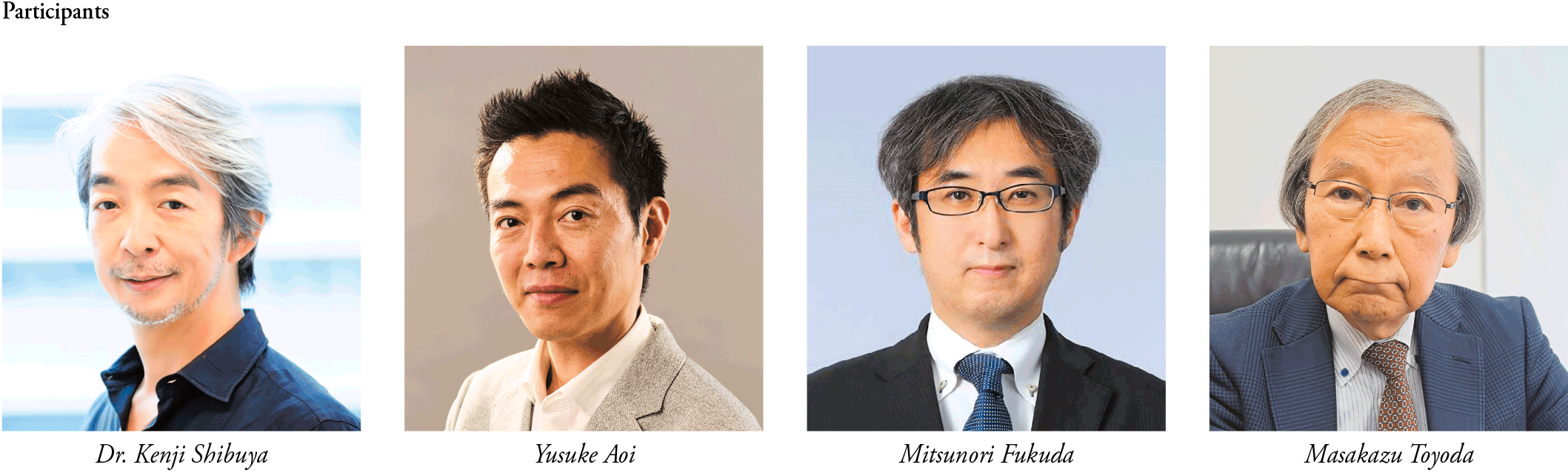
Participants
Dr. Kenji Shibuya, CEO of Medical Excellence Japan (MEJ)
Yusuke Aoi, General Manager of the 1st Department, Provider Division, Wellness Business Unit, Mitsui & Co. Ltd.
Mitsunori Fukuda, Director, Healthcare Industries Division, Commerce and Service Industry Policy Group at the Ministry of Economy, Trade and Industry (METI)
Moderator: Masakazu Toyoda, chairman & CEO, Japan Economic Foundation (JEF)
Introduction
Medical tourism in Japan has great potential, given the country's advanced medical technology and rich tourism resources, and the Japanese government, hospitals and businesses are ready to promote it. Experts from these three areas discuss ways to develop and achieve this potential, and how to overcome possible challenges along the way.
Toyoda Medical tourism refers to the phenomenon of traveling across borders to receive medical services while also enjoying tourism. Recently, it has attracted the attention of many people worldwide. Various reasons are cited, such as "desiring better treatment", "seeking more affordable treatment", "wanting to enjoy sightseeing during recovery or while awaiting diagnosis results", and "hoping to experience lower living costs and interact with locals who are welcoming to foreigners". According to mediPhone, a Japanese company providing support services for foreign patients, estimates suggest the global market size will nearly triple from 14 trillion yen to 48 trillion yen over the six-year period from 2022 to 2028.
Several countries in Asia are developing medical tourism and attracting attention, including Thailand, Singapore, Malaysia, and South Korea. According to a report by the Ministry of Economy, Trade and Industry's "Study Group on Ideal Approaches to the Appropriate Promotion of Medical Tourism" published in June 2025, Thailand is reported to have received approximately 3 million medical travelers in fiscal year 2023. Singapore, while said to have remained flat in recent years, is estimated at around 500,000. Malaysia reached approximately 850,000 in 2022 (including foreign residents), and South Korea is reported to have had about 600,000 travelers in 2023.
In contrast, the number of medical travelers to Japan is extremely limited, estimated at only 20,000 to 30,000. Given that the number of foreign visitors to Japan this year is projected to exceed 40 million, this figure is remarkably small. Recently, both the Ministry of Health, Labour and Welfare and METI appear to be considering various policies for medical tourism, recognizing its importance for Japan as well.
Today, we have invited three experts to discuss how Japan, like other Asian countries, can develop medical tourism. First is Dr. Kenji Shibuya, CEO of Medical Excellence Japan (MEJ), which supports the international development of Japanese medical care. Dr. Shibuya also has experience as a professor in the medical research departments at King's College London and the University of Tokyo.
Second, Mr. Yusuke Aoi, general manager of the 1st Department, Provider Division, Wellness Business Unit, Mitsui & Co. Ltd. As the largest shareholder of Malaysia-based IHH Healthcare, the company is driving innovation in health care across Asia. IHH Healthcare is a hospital operator with approximately 80 hospitals across 10 Asian countries.
Third, Mr. Mitsunori Fukuda, director of the Healthcare Industries Division, Commerce and Service Industry Policy Group at METI. This division held the study group mentioned at the outset.
Why Medical Tourism Is Important for Japan
Toyoda So let's proceed with the first of our four questions. This is a general question: why is medical tourism fundamentally important for Japan? I'd like to hear from Dr. Shibuya from the perspective of the medical professionals, Mr. Aoi from the industrial perspective, and Mr. Fukuda from the government perspective on what you consider the most important points.
First, Dr. Shibuya, please speak from the perspective of medical professionals.
Shibuya The significance of medical tourism lies not only in its benefits for foreign patients, but also ultimately in serving Japan's national interests, which in turn contributes to promoting the health of the Japanese people. Fundamentally, we must first strengthen the operational foundations of Japan's medical institutions. I think this is of utmost importance.
With bed occupancy rates currently low, even university hospitals have quite a few vacant beds available, so I think opposition to utilizing them has actually been decreasing. Amid growing fiscal deficits, I think public healthcare spending should fundamentally increase, given our aging population. However, political circumstances and public opinion make this difficult. Therefore, we must also develop medical services covered outside public insurance as a new market. Given these factors, strengthening the operational foundations is crucial.
Moreover, even at university hospitals, there is a growing crisis: amid persistent deficits and understaffing, the drive to pursue advanced medical care is gradually fading. Medical care ultimately requires innovation and proactive experimentation to advance. Furthermore, from an economic security perspective, economic security cannot be achieved without such cutting-edge industries. So we must promote the development of advanced medical care from a medium- to long-term viewpoint. To that end, we should also capture overseas markets.
For example, as you all know, Japan is advanced in regenerative medicine. However, if commercializing regenerative medicine immediately proves difficult in terms of both quality and technology, one approach could be to initially apply such cutting-edge technology to overseas patients, who wish to embrace new medical technologies, visiting Japan, and ultimately expand it overseas.
Another point is that when we talk about foreigners, it's not just people from overseas; there are actually quite a few residents here now. These resident foreigners are generally covered by Japan's health insurance system. Establishing this system also holds significance in addressing challenges related to language and culture for these individuals.
Toyoda Thank you. Now, I'd like to ask Mr. Aoi to share his perspective from the industry standpoint.
Aoi Our company operates hospital businesses in Asia, primarily in countries such as Singapore, Malaysia, India, and Turkey, where medical tourism is actively pursued in each region. While our company does not have any particular position for or against the importance of medical tourism within Japan's non-profit healthcare system, we recognize that Japan possesses highly advanced medical equipment and diagnostic technologies. With inbound demand reaching unprecedented levels, we believe the potential is enormous if the government and industry stakeholders adopt a proactive stance to promote it. Furthermore, as other countries have already pioneered this field, there is much we can learn from their examples as we move forward.
Toyoda And from the government's perspective, I'd like to ask Mr. Fukuda to comment.
Fukuda As you pointed out, our Healthcare Industries Division held an inbound study group and compiled its findings into an interim report this past June. The discussions in this study group began by redefining what exactly medical inbound tourism entails and where we should focus. Our focus is treatments and advanced medical examinations provided by medical institutions to foreign patients under private medical care.
Regarding its significance, providing advanced medical services to foreign patients will contribute to the development of Japanese health care through the enhancement of cutting-edge medical technologies, which also benefits Japanese citizens. Additionally, it may help compensate for the decrease in domestic patient numbers. Ultimately, this could serve as one of the "prescriptions" to improve Japanese medical institution's management and to ensure the sustainability of the healthcare delivery system.
By further expanding medical tourism, we can help medical institutions that provide advanced medical care to secure new revenue sources. This, in turn, will allow them to acquire funds for investments in cutting-edge medical technologies, leading to improvements in hospital management. I believe that such initiatives will contribute to enhancing the sustainability of Japan's medical service system. This is our perspective on the significance of medical inbound.
Factors Hindering the Development of Medical Tourism in Japan
Toyoda Now, for the second question. I'd like to ask why medical tourism hasn't developed in Japan to the same extent as in other Asian countries. This time, I'd like to hear from Mr. Aoi. I would also appreciate it if you could mention the current state of medical tourism in other Asian countries.
Aoi In Singapore, it's around 500,000 people, and in Malaysia, 850,000. Either way, overseas countries see a significant number of medical tourists visiting. In contrast, Japan only has tens of thousands, making it very small by comparison.
Our company manages IHH, and in Malaysia and Singapore tourists come relatively more from within Southeast Asia - countries like Indonesia, the Philippines, and Vietnam. India, meanwhile, sees medical tourists primarily from the Middle East, with which it shares deep historical ties. Turkey also has the characteristic of attracting tourists from Europe due to its currency depreciation. Furthermore, within each region, the purposes vary: some countries send people seeking more advanced medical care than available domestically, while others come seeking a certain level of medical care at a lower cost. In any case, this activity is thriving.
Why is medical tourism thriving overseas? While each country and region has its own characteristics, one key factor for IHH is the reassurance provided by its high-quality medical care options. In addition to local certifications, we have multiple hospitals holding international accreditations, such as the Joint Commission International (JCI).
Secondly, there is the convenience of location. Singapore is a prime example, offering the accessibility of being just a single flight away from anywhere in Southeast Asia, reachable within a few hours. Furthermore, once you arrive at the airport, you can reach the city center in about 20 minutes, so it's convenient for domestic travel as well.
Additionally, there is the aspect of countries actively addressing multiculturalism and language needs. For instance, hospitals in Singapore and Malaysia provide language support for English, Indonesian, Chinese, and even Hindi. Within this framework, I think progress is being made in making it easier for patients to seek care across national borders.
Toyoda Mr. Fukuda, the study group you mentioned earlier also describes examples from other countries. It seems the government's level of commitment differs as well. I would appreciate it if you could speak from the government's perspective.
Fukuda While countries like Thailand, Singapore, Malaysia, and South Korea are quite advanced as leaders in medical tourism, Japan's estimated number of medical travelers is only 20,000 to 30,000. In that sense, it's said that Japan's medical tourism policy has been somewhat restrictive, which may be one contributing factor.
However, discussions within the study group suggest that the background to this was likely the difficulty in reaching consensus on medical inbound tourism among governments and industry stakeholders, necessitating a cautious approach to the discussions.
As I mentioned earlier, I believe clarifying the definition of medical inbound tourism was also a key point in our study group's report. We defined medical inbound tourism as strictly pertaining to the private medical services offered by healthcare institutions. Without establishing such definitions one by one, there was a risk that stakeholders would lack a shared understanding, leading to discussions that failed to align.
For instance, I suspect one underlying factor is that discussions have been muddled and failed to align because they didn't properly distinguish between public insurance-covered medical care for foreign residents, emergency care covered by private medical care for foreign tourists visiting Japan, and medical inbound care covered by private medical care for foreigners coming to Japan for treatment. Therefore, we have defined it within this study group and have been working to advance the discussion a bit.
However, the primary purpose of medical inbound initiatives has always been to provide foreign patients with Japan's advanced medical services while simultaneously ensuring the sustainability of medical institutions' operations and healthcare delivery systems. It goes without saying that in promoting these measures, there must be no adverse impact on the provision of medical care to domestic residents.
Given these points to consider, I think the current situation necessitates that relevant ministries and agencies collaborate, fully listen to the opinions of medical professionals, and advance necessary measures to enable foreign patients and Japanese healthcare providers to build a mutually beneficial relationship.
Toyoda Dr. Shibuya, medical doctors in Japan have a natural inclination to prioritize treating Japanese patients first. Is it correct to say that this mindset has contributed to medical tourism not becoming very widespread in Japan? Could you please explain this point?
Shibuya About a year and a half ago, when I became MEJ's CEO, it was said that medical inbound tourism wasn't progressing at all. So we conducted in-depth interviews with foreign patients about their patient journey from leaving their home country until returning there, and also with medical professionals themselves.
Ultimately, what I believe is that in Japanese hospitals, the well-established public insurance system means hospitals can attract many patients without needing to focus much on service quality. Compounded by structural factors like healthcare cost containment, physician shortages, and progress in work-style reforms, the medical field is currently exhausted. Meanwhile, many hospitals are operating at a loss. Even if hospital directors consider accepting foreign patients to increase revenue - since they can charge triple the medical fees under the free medical treatment - the medical field simply cannot bear any more burden.
In short, the current situation is that while patient complaints and demands are increasing, payments are being restrained, and all the burden is falling on the medical staff. Under such circumstances, it is difficult to rapidly expand medical tourism.
From an international perspective, health care also has a strong industrial aspect. As healthcare needs are expected to diversify and increase going forward, the scope for public spending is limited amid significant fiscal deficits. In this context, private-sector-led investment and an entrepreneurial mindset focused on investing where demand exists are common internationally. Japan should similarly engage in discussions about viewing health care as an industry.
Given this situation, I believe foreign patients won't come unless we first address the hospital's current inefficient structure and lack of patient-centered service perspective. There are two major aspects to this: the journey from the patient's home country to the hospital, and the hospital experience itself. The hospital experience involves the hospital's infrastructure - things like patient services, concierge-like functions for high-end patients, and integrating insurance companies so that everything from travel to hospitalization and treatment is settled in one transaction. These are hospital functions, which fall under the jurisdiction of the Ministry of Health, Labour and Welfare. Discussions during former minister Keizo Takemi's tenure brought significant change here. The Medical Affairs Bureau at the ministry also became very proactive. That was in 2024.
Another issue is the journey from overseas to the hospital. When leaving their home country to come to a hospital, no one knows which Japanese hospitals offer what treatments or at what cost. So they end up going wherever an agent happens to refer them. Essentially, Japan lacks a system that prioritizes the user's perspective. For example, when you go on a regular trip, you can search on travel portal sites and immediately find information about services and their costs.
Then there's the visa process. A visa that takes one week to obtain in Singapore now takes a month in Japan. So, for example, Vietnamese patients might decide to go to Singapore instead.
Furthermore, there are cases where travel support companies get involved afterward, and various fees are collected without the user's knowledge. From the perspective of such companies, it's understandable that they set prices higher due to low profit margins and high volume, plus the risk of cancellations. But the bottom line is that the system isn't designed to be convenient for the user.
Japan's medical standards themselves are very high, so I think foreign customers will be satisfied if we improve these areas. Streamlining the process for patients coming to Japanese hospitals requires collaboration with METI to build a platform incorporating digital solutions. Regarding hospital system development, we need the Medical Policy Bureau at the Ministry of Health, Labour and Welfare to take a proactive stance. Currently, the ministry is working with several hospitals on such system development.
The key point is that even hospitals cannot reinvest or hire staff without a certain level of profit, and it is crucial to recognize that this model is not sustainable.
Developing Medical Tourism in Japan
Toyoda Moving on to the third question. In Japan, what should be done to promote the development of medical tourism? There may be issues of inefficiency, but the question is what should be done. I'd like to ask Mr. Fukuda first. I believe the Japanese government is seeking to promote medical tourism, but what do you think it can do?
Fukuda I don't believe all medical institutions are capable of accepting medical inbound patients. I think one crucial step is to establish model institutions that are willing to accept these patients and remain competitive. This is something we must pursue in collaboration with the Ministry of Health, Labour and Welfare. In addition, I believe marketing activities will be necessary.
To facilitate the dispatch of overseas patients, collaboration with local medical institutions is essential. Furthermore, we believe it is necessary to establish a platform that will comprehensively support efforts such as streamlining operational workflows through collaboration between local and Japanese medical institutions, and promoting Japanese medical institutions. MEJ possesses a framework called the "MExx Concept" for collaborating with countries of origin, and we aim to build this platform in a manner that integrates with that framework. We, too, intend to work with the Ministry of Health, Labour and Welfare to advance the development of such platforms and engage in medical inbound initiatives.
Toyoda Next, I'd like to ask Dr. Shibuya what we should consider to be the highest priority among improvement measures. Looking at the government, the medical industry, related industries, and the whole picture, where do you think changes are necessary? Additionally, Japan boasts hot springs with significant tourism value. Could hot spring therapy be integrated with medical care? What are your thoughts on this matter?
Shibuya I think the most crucial improvement would be for the government to clearly state that it's acceptable for the medical field to industrialize and generate profits. Health care is a major industrial sector, and it must be protected. To achieve this, it is crucial for the government to demonstrate its commitment to supporting it as an industry. In fact, since last year, the winds have shifted significantly.
In this situation, there are two key actions to take. First is the establishment of domestic and international systems, as I mentioned earlier. This involves enabling hospitals to partner with global insurance services for seamless payment processing, or implementing truly global concierge-like systems. The other key point is to aim for user-centric services for our patients. The reason Japan has attracted so many tourists is that we did the obvious: data-driven marketing to reach out to users. If Japan doesn't start doing something similar in medical tourism, even if healthcare providers tout Japan's hospitality and advanced medical technology, people simply won't come. Even if you ask hospital doctors, medical tourism is now welcomed, so we should definitely support it in that way.
Above all, it's crucial to reduce the burden on the medical staff and doctors in hospitals and to think thoroughly from the user's perspective. The biggest flaw in Japanese systems is that when we build systems based solely on our own convenience, we end up with situations that aren't convenient for the most important users. That's something I always keep in mind.
As for hot springs, when you look at people from Southeast Asia, such as in Thailand, the wealthy - the chaebol types - love hot springs. Thai chaebol come to hot springs about once every two months. Thailand is now fully promoting wellness as its next major industry, and I think Japan has a lot to learn from that.
When we talk about wellness, it's not just about spas and massages. Combining it with things only possible in Japan, like regenerative medicine, and supporting it as the next-generation wellness industry would be ideal. These kinds of preventative and health-promoting services fall under private medical care. I believe there's an opportunity for such services to establish themselves as a new market.
With so many repeat visitors to Japan now, and since local cuisine can only be enjoyed in its place of origin, I think inbound tourism is hugely popular. Personally, I think combining this with health care or wellness could become a model for regional economic development.
India is similar. Beyond medical tourism through hospitals, Prime Minister Narendra Modi is promoting a campaign called "Heal in India" based on Ayurveda (traditional Indian medicine). There is a ministry dedicated to Ayurveda called the Ayush Ministry, and we are in discussions with them. The question is how to create a wellness industry that combines India's traditional medicine with modern science. If we can do that, it could potentially create a market encompassing not just the travel industry, but also various related industries like food.
There's a lot of talk these days about overtourism. The fundamental problem is that narrow streets and residential areas become overrun with tourists because too many visitors arrive before the infrastructure can handle them. But I recently spoke with an American expert who mentioned that Orlando, home to Disneyland, has a combined population of only about 3 million in the surrounding area but welcomes around 75 million tourists annually. Yet, despite being a city slightly larger than Kyoto (population 1.4 million), it doesn't suffer from overtourism. In fact, residents' quality of life has improved. Why? Because they've separated the tourism segment from actual residential areas, facilities are well-developed, and ride-sharing is standard. Then there's the 6% lodging tax, which is reinvested, and a locally sourced food ecosystem. To achieve this, both domestic and international marketing, along with domestic infrastructure development, are crucial.
If we accept patients before establishing such systems, it can turn negative in the long term. To avoid this, medical tourism should first prioritize developing the necessary infrastructure, including hospitals. Right now, the government is taking action and the medical community is eager to get involved, so I think we must not let this momentum fade. We think there is a great change developing in our health care, in the sense that the term "industry" is now being used.
Toyoda Mr. Aoi, what can private companies do to promote the development of medical tourism? Since trading companies can handle various matters, I was wondering if what Dr. Shibuya mentioned could also be achieved by a trading company. What are your thoughts?
Aoi Looking at overseas examples, I considered what aspects could be useful for us. For instance, IHH places great emphasis on coordinating the entire patient journey through a one-stop service for medical tourism.
For example, they've consciously built a one-stop service starting with a call center-like hotline where patients can consult in their native language before traveling. Upon arrival at the airport, they prepare an IHH patient lounge functioning as a hospital. They offer airport pickup service, and the hospital itself has a tourist lounge. For the return trip, they provide drop-off service, and they also conduct follow-up care. While many of those services are handled in-house in the hospital, they partly utilize partners or agents.
Looking at Japan, while the use of medical coordinators is expanding, it remains in its developmental stages. As a result, issues like visa applications, claim procedures, and collecting unpaid bills still pose significant challenges. Language support is another key concern. Since medical institutions often lack the capacity to handle these internally, creating a one-stop service to reduce their burden is crucial.
Organizations like IHH have dedicated international marketing teams, and I believe overseas marketing is a crucial factor. It's not just about waiting for patients in Japan; it's about how to attract patients from abroad. For example, in Singapore, the marketing team routinely organizes activities like bringing Singaporean doctors to Indonesia to host seminars and events. Through such efforts, collaboration between referring and receiving hospitals is promoted, and systems are developed to include the exchange of medical information before and after treatment.
To reach the level where you can maintain such a specialized overseas marketing team, a corresponding volume of medical tourism is also necessary. While I believe this is a future prospect, such practices are already being implemented overseas.
Toyoda Thank you. I have an additional question for Mr. Aoi. Regarding the airport lounges mentioned earlier, are these operated by the airlines? Or does the hospital itself secure such facilities? Could you clarify whether the hospital is the primary operator, or if surrounding airlines or travel agencies play a central role?
Aoi The meeting area inside the airport is a space leased by the hospital under its brand name. It's not a very large space, but it's designed to be a comfortable waiting area for patients until their pickup arrives.
Toyoda Dr. Shibuya's point is that without adopting the mindset of industrializing health care, Japan ends up in a situation where doctors feel compelled to provide amenities like lounges.
Shibuya In my view, doctors don't need to become business managers. We should create an environment where doctors can focus on what they should be doing in the first place. The key is to provide them with an environment, including the medical staff's working conditions, where they can deliver the best possible care to the patients right in front of them. Business management, service operations, and marketing should be handled by professionals.
One of the problems today is that it has become like "healthcare providers should handle everything." I think we need to free them from that burden. It's crucial to properly create an environment where doctors can focus on what they should be doing.
Points to Consider in Promoting Medical Tourism
Toyoda This is my final question. I would like to ask about the points to be mindful of when promoting medical tourism. What factors are at play? I'd like to ask Dr. Shibuya. Japan's population is declining, and particularly in regional medical institutions there seems to be a surplus of hospital beds. What are your thoughts on this?
Shibuya As you say, large hospitals in rural areas especially are fundamentally operating at a loss, and their bed occupancy rates are declining. There's no factor that will increase this. So, we must consider how to utilize them, and I think it's a reasonable and rational decision to have foreign nationals use them to improve their management.
At the same time, however, we must be careful to communicate domestically that promoting medical tourism from an industrial perspective ultimately benefits Japanese citizens as well. Inbound tourism is growing, the number of foreigners who love Japan is increasing, and the outpouring of affection for Japan is tremendous. Furthermore, the government and relevant ministries are also discussing the idea of promoting medical tourism. It is also necessary to raise awareness among the general public in Japan.
Toyoda Thank you. Mr. Aoi, based on your experience in Asia, are there any particular points Japan should be mindful of?
Aoi Looking at Singapore and Malaysia, we see that as medical costs rise, there are noticeable shifts - for instance, patients who used to come from Indonesia to Singapore are now going to Malaysia instead. Meanwhile, Singapore is pursuing its own developmental path. IHH has established Singapore's first proton therapy facility, positioning advanced medical technologies such as proton therapy, robotic surgery, and CAR-T therapy as its signature offerings. Furthermore, Malaysia offers high-quality medical care options at relatively low costs, and I get the impression that it is leveraging this strength to target the volume segment of medical tourism.
In other words, it appears that each country is promoting its own unique characteristics and engaging in targeted marketing. Observing this situation, if Japan is to actively embrace medical tourism, given that Japan is a large country with diverse regional characteristics and varying hospital circumstances, it will be crucial for each hospital to develop distinctive marketing strategies. For instance, should they focus primarily on accepting patients seeking advanced medical care? Or should they target the volume segment for health checkups and specialized medical services? Alternatively, could they combine these with resources like the hot springs mentioned earlier or tourism attractions to create unique offerings? I believe highlighting each hospital's unique characteristics through marketing will be key.
Toyoda I think the term "marketing" is extremely important. It seems that aspect is still lacking in Japan's current medical tourism efforts. I also think METI is becoming more enthusiastic about it. Finally, Mr. Fukuda, what are your thoughts?
Fukuda For the government, it is important that these efforts contribute to strengthening industrial competitiveness. Furthermore, as I mentioned earlier, it is crucial that it substantially contributes to the sustainability of the healthcare delivery system. Naturally, it must not undermine the domestic healthcare delivery system. I believe the situation requires the government to carefully listen to the opinions of healthcare professionals and others, and to strategically address this issue.
Furthermore, we believe the role of ERIA, the Asian version of the OECD, is also crucial for our expansion in Asia. By building networks with local stakeholders and fostering collaboration between medical institutions and governments, we believe this can contribute to promoting medical tourism. To that end, we have high expectations for the contributions of both MEJ and ERIA.
Toyoda I also think this is a very important field. Japan possesses outstanding medical technology and remarkable tourism resources. I look forward to your continued contributions, as I think the sound development of medical tourism can create a healthier world, not just in Asia. Thank you very much.
Written and translated by Naoyuki Haraoka, editor-in-chief of Japan SPOTLIGHT, with the cooperation of Tape Rewrite Co.